

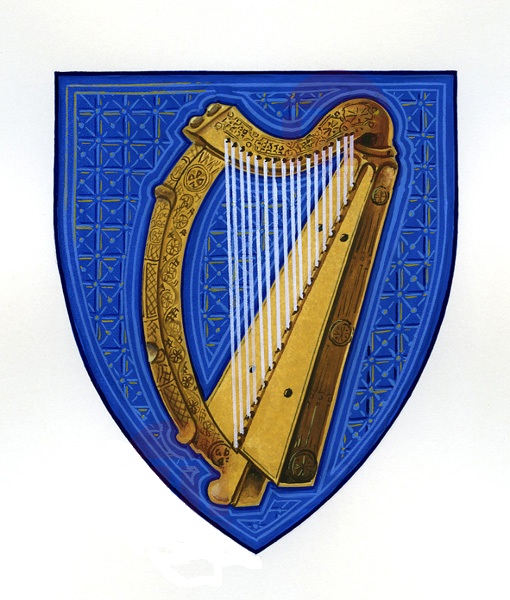
THE CLAN McGRATH IN HERALDRY
It is important to note that there is no such thing as a family or clan coat of arms . A coat of arms is granted to an individual and can be displayed the bearer and their descendants with due deference. A coat of arms can also be granted to a public or local authority, corporate body or other entity / organisation.
In Ireland, a number of coats of arms, usually the personal arms of an individual of that name, as recorded in the Office of the Chief Herald of Ireland / Office of Arms in Dublin, are generally accepted as appertaining to particular Irish clans or septs.
Guidance on this matter is taken from Edward MacLysaght’s book, ‘Irish Families, Their Names, Arms and Origins’.
It must be emphasised that the acceptance of the principle of clan or sept arms in no way implies that they are to be used or displayed as personal arms by any individual member of a clan or sept.
The Clan McGrath Society’s position is that the arms illustrated on the title header of this website and used on our correspondence, are not and should not be misappropriated, displayed, or put forward as an individual personal achievement of arms.
Accepting this guidance, the Clan McGrath has adopted what is generally known as ‘the McGrath Coat of Arms‘ as a graphic representation of our collective clan heritage. The Clan McGrath Society does not make any claim to the arms other than as a symbolic and historic emblem of kinship.

If any person wishes to bear arms in the true heraldic sense, they should become armigerous in their own right. You are strongly advised to seek a grant of arms from the Chief Herald of Ireland or the relevant heraldic authority in your own country.
Records show that the McGrath coat of arms have been in existence since at least the 16th century. These arms were the armorial bearings of Archbishop Miler McGrath and appear on his tomb at the Rock of Cashel dated 1622. However, in a contemporary painting of Archbishop Miler McGrath dated 1570, he is shown with arms displaying: Ar. three lions passant, Gu. that is three red lions on a white field. These arms are the arms of Miler’s Father, Donncha McGrath, Chieftain of Termonmagrath and the Termoner / Coarb of Lough Derg in Ulster. An hereditary ecclesiastical office and title in Gaelic Ireland.
The tree red lions are replicated in the later arms of Archbishop Miler McGrath when they are used by him in the first quarter of the arms of his tomb. It is likely that these arms, reproduced on this website as the arms of the Clan McGrath, were adopted or designed for the Archbishop and represent an amalgamation of his Father’s arms and other symbols both religious and secular.
Both Archbishop MIler’s and Donncha’s arms are listed in ‘Irish Pedigrees: The Stem of the Irish Nation’ by John Hart and in ‘Irish Families, Their Names, Arms and Origins’ by Edward MacLysaght.
As an Archbishop who spanned the 16th and 17th centuries it was expected that MIler would hold arms and he is entombed bearing these very arms at the Cathedral Church of the Rock of Cashel.

THE ARMS
There are a number of variations on the McGrath arms and there are also differing interpretation of what is meant by the images on the arms.
The arms are recorded in their present form by Sir Richard Carney, Ulster King of Arms. The office of the Ulster King of Arms was the heraldic authority in Ireland prior to the establishment of the Irish Republic in 1947, when the Office of the Chief Herald of Ireland was established in its place.
During the Commonwealth which followed the English Civil War and the death of King Charles I, Richard Carney was made “Principal Herald of Arms of the whole Dominion of Ireland,” an office he held until August 1660. After the Restoration he was appointed, in 1661, Athlone Herald and was made Ulster King of Arms in 1683 and was knighted on 6th April, 1684. He died in 1692. Sir Richard Carney, Ulster, temp. Jac. II., gives the McGrath coat of arms as follows, which appears with some variation, to be similar to those depicted on the tomb of Archbishop Miler:
1. Argent, three lions passant gules.
2. Or, a dexter hand fesseways, couped at wrist ppr., holding a cross formee (pattee) fitchee azure.
3. Gules, a dexter hand fesseways, couped at wrist ppr., holding a battle axe or.
4. Argent, an antelope trippant sable attired or.
Note: The lions depicted on the tomb are lions passant guardant and the demi antelope on the tomb is rampant.
However, only the herald who granted them or Archbishop Miler himself who may have assumed them, really knows the true meaning of the arms and the passage of time has meant that much of the significance of the symbolism has been lost to history. However, by examining the context of the arms we can piece together an interpretation of what the symbols may mean and they do correspond with Archbishop Miler’s life in the Church.

1. Three Lions Passant have a long history in heraldry and as detailed above three lions are recorded in use by the McGrath Chief in Ulster. Three lions gules (red) passant appear on a field argent (silver / white) appear in a coat of arms painted on a a portrait of Archbishop Miler McGrath dated 1570. These were the arms of his Father. The three lions also has a significance among the Dal gCais families and there are many variations on this theme in Irish heraldry. According to tradition, the Clan McGrath are descendants of the Dal gCais and the O’Briens, originating on the banks of the River Shannon in Co. Clare and in the ancient kingdom of Thomond. In the modern interpretation of the arms..
2. The Cross Formee Fitchee is often used to denote Bishoprics and Archbishoprics in both the Catholic and Anglican traditions.
3. The Battle Axe possibly a symbol of authority and defence of the faith.
4. The Antelope in medieval heraldry the antelope may have had a religious significance, ‘The antelope’s two horns represent the biblical Old and New Testaments, with which people can cut themselves free of vice’. The antelope has also been used as an emblem of purity and fleetness.
5. The motto: SALUS IN FIDE, Salvation in / by or through faith.
 CLAN MCGRATH SOCIETY